

By: Owner & Attorney, Michael Jonas, JD, MBA
Communities are strongest when organizations work together.
Across Oregon and Washington, nonprofits, businesses, public agencies, schools, tribal governments, foundations, neighborhood associations, faith communities, and community groups partner every day to solve problems that no one organization could solve alone. Whether the goal is creating affordable housing, revitalizing a downtown corridor, hosting a fundraising event, improving educational opportunities, supporting local businesses, or expanding access to healthcare, meaningful change almost always requires collaboration.
No single organization has every resource, every expertise, or every solution. Collaboration allows organizations to combine strengths, leverage funding, share knowledge, and create greater impact.
Unfortunately, documenting those collaborations is often treated as an afterthought.
One of the biggest mistakes organizations make is assuming every partnership should use the same agreement. Some download an MOU from the internet. Others rely on a handshake or an email chain. Still others call every relationship a "partnership" without considering the legal implications.
The reality is that different relationships require different legal tools.
Sometimes the relationship is primarily about marketing and recognition. Sometimes it is about organizations coordinating services. Sometimes organizations are jointly developing affordable housing, sharing ownership of a new venture, or negotiating benefits for an entire neighborhood. Other times, an organization simply wants to document shared intentions while preserving flexibility.
Choosing the right agreement creates clarity from the beginning. It establishes expectations, allocates responsibility, protects relationships, and helps organizations avoid disputes that can distract from their mission.
Just as importantly, organizations should think beyond the agreement itself. Tax implications, governance, insurance, intellectual property, employment law, grant compliance, donor restrictions, and liability often deserve just as much attention as the document itself.
This guide explores six of the most common agreements used by nonprofits, businesses, developers, public agencies, and community organizations throughout Oregon and Washington, along with examples, common pitfalls, and practical legal considerations.
Sponsorship Agreements
A Sponsorship Agreement is appropriate when a business or organization provides money, goods, or services in exchange for recognition or promotional benefits.
Unlike a charitable donation, sponsorships are intended to create value for both parties. The nonprofit receives financial or in-kind support while the sponsor receives visibility, marketing opportunities, or public recognition.
Examples include a Portland credit union sponsoring a nonprofit gala, a Vancouver construction company sponsoring a workforce development conference, a Seattle healthcare provider sponsoring a community health fair, a Salem brewery sponsoring a neighborhood festival, an outdoor recreation company sponsoring a trail restoration event, or a regional law firm sponsoring a nonprofit annual meeting.
A well-drafted Sponsorship Agreement should clearly define the sponsorship amount, payment schedule, promotional benefits, logo usage, ownership of marketing materials, event responsibilities, cancellation procedures, insurance obligations, indemnification, and dispute resolution.
Organizations should also remember that sponsorships and charitable donations are not the same thing. If a sponsor receives significant advertising or promotional benefits, the payment may be treated differently for tax purposes than a charitable contribution. Understanding that distinction early can help both organizations avoid unintended tax consequences. Depending on the circumstances, sponsorship revenue may also have unrelated business income tax implications for charitable organizations.
Community Partnership Agreements
Many collaborations are not sponsorships at all. Instead, organizations simply want to work together toward a shared goal while remaining legally independent.
A Community Partnership Agreement defines how those organizations will collaborate while preserving each organization's separate identity. These agreements often address responsibilities, communication, decision-making, funding, publicity, confidentiality, intellectual property, insurance, reporting, and how the partnership may end.
Examples include a nonprofit partnering with Portland Public Schools to provide after-school tutoring, a Vancouver nonprofit working with Vancouver Public Schools on youth mentoring, a Seattle arts organization partnering with the public library to offer free workshops, multiple nonprofits coordinating a community resource fair, a chamber of commerce partnering with a nonprofit to operate a small business incubator, a city partnering with neighborhood organizations to activate a public plaza, or a healthcare provider partnering with a housing nonprofit to deliver wraparound services.
These agreements become increasingly important when organizations share grant funding, volunteers, staff time, facilities, equipment, or public recognition. They should also clearly address who has authority to make decisions, who owns jointly created materials, who is responsible for insurance, and whether either organization has authority to bind the other.
Joint Venture Agreements
Sometimes organizations want to do more than collaborate. They want to build something together.
A Joint Venture Agreement is appropriate when organizations combine resources to pursue a specific project while sharing governance, financial risk, responsibilities, and often ownership. Many joint ventures create a new LLC or other legal entity to carry out the project.
Examples include a nonprofit affordable housing developer partnering with a private developer to construct mixed-income housing, two construction companies forming a joint venture to pursue a public infrastructure project, a nonprofit healthcare provider and hospital jointly operating a behavioral health clinic, a tribal government and private company developing renewable energy infrastructure, a nonprofit and business launching a social enterprise that generates earned revenue while advancing a charitable mission, or multiple developers partnering on a large mixed-use redevelopment.
Joint Venture Agreements should address governance, capital contributions, voting rights, financing, tax treatment, intellectual property ownership, dispute resolution, buyout rights, exit procedures, and what happens if one party defaults. They are often among the most sophisticated agreements organizations enter into because they combine legal, financial, tax, operational, and governance considerations.
If organizations are sharing ownership, profits, losses, governance, or financial risk, they have likely moved beyond a Community Partnership Agreement and into Joint Venture territory.
Community Benefit Agreements
Community Benefit Agreements, commonly called CBAs, help ensure that major development projects benefit the communities where they are built.
Rather than relying on promises made during public meetings, developers and community organizations negotiate specific commitments that become part of a written agreement.
Examples of community benefits include affordable housing, local hiring commitments, apprenticeship programs, minority-owned business participation, affordable commercial space for local entrepreneurs, public art, parks and open space, childcare facilities, community meeting space, environmental improvements, workforce development, transportation improvements, and investments in neighborhood organizations.
Throughout the Pacific Northwest, Community Benefit Agreements are increasingly discussed in connection with redevelopment projects, urban renewal, transit-oriented development, waterfront redevelopment, and major institutional expansions. As Portland continues to redevelop areas such as the Broadway Corridor and Lloyd District, and as communities throughout Oregon and Washington continue to grow, Community Benefit Agreements provide one tool for ensuring that economic development also creates lasting community benefits.
A good Community Benefit Agreement identifies measurable commitments, reporting requirements, timelines, enforcement mechanisms, and community accountability.
Gift-in-Kind Agreements
Not every contribution comes in the form of cash.
Businesses and individuals frequently donate computers, furniture, construction materials, software, meeting space, food, legal services, accounting services, marketing, equipment, or professional expertise. These contributions can be just as valuable as financial donations.
A Gift-in-Kind Agreement documents exactly what is being donated, when it will be provided, whether ownership transfers, whether restrictions apply, and each party's responsibilities.
Examples include a Portland law firm donating legal services to a nonprofit, a Seattle technology company donating laptops to a youth mentoring organization, a Vancouver contractor renovating a shelter, a coffee roaster donating beverages for a fundraising event, a marketing agency designing a nonprofit's website, or an accounting firm providing pro bono financial services.
Organizations should also think carefully before accepting donations. Contrary to popular belief, not every gift should be accepted. Property with environmental contamination, expensive maintenance obligations, significant debt, restrictive donor conditions, or ongoing storage costs may ultimately burden an organization more than help it. Many nonprofits benefit from adopting a board-approved Gift Acceptance Policy.
Tax issues also matter. Contrary to popular belief, not every nonprofit can offer charitable tax deductions. While donations to organizations recognized under Section 501(c)(3) of the Internal Revenue Code are generally eligible for a charitable deduction if applicable legal requirements are met, contributions to many other nonprofit organizations are not.
Fiscal sponsorship creates another common misunderstanding. Organizations operating under a fiscal sponsorship should generally not simply provide the fiscal sponsor's Employer Identification Number (EIN) to donors or ask donors to write checks to the sponsored organization if they expect a charitable deduction. Donations intended to qualify for a charitable deduction should generally be made directly to the fiscal sponsor in accordance with the fiscal sponsorship agreement and the sponsor's gift acceptance procedures.
Organizations should also remember that while they should acknowledge gifts in kind, they generally should not assign a monetary value to donated property in their acknowledgment letters. Determining value is generally the donor's responsibility.
Memorandums of Understanding (MOUs)
Not every collaboration requires a lengthy contract.
A Memorandum of Understanding (MOU) is commonly used to document shared goals, intentions, and general responsibilities while allowing flexibility as a relationship develops.
Contrary to popular belief, an MOU is not automatically legally binding simply because it is signed. Likewise, calling a document an "MOU" does not automatically make it non-binding. Whether an MOU is enforceable depends on the language used, the parties' intent, and whether the document contains sufficiently definite and certain terms to create an enforceable contract.
This is where organizations often run into trouble.
MOUs are frequently written in broad, aspirational language describing how organizations hope to work together. That flexibility can be valuable, but it often leaves important questions unanswered about payment, performance standards, ownership, liability, deadlines, or remedies if one party fails to perform.
Organizations should decide from the outset whether the document is intended to serve as a roadmap for collaboration or as a legally enforceable agreement.
If the goal is simply to establish a shared vision, strengthen communication, and identify general expectations, an MOU may be the appropriate tool.
If the parties intend to create binding obligations, establish deadlines, transfer intellectual property, allocate liability, require payment, or create enforceable rights and remedies, they should generally use a formal contract instead.
In many situations, the best solution is to use both. An MOU can establish the broader collaborative relationship while a separate grant agreement, services agreement, fiscal sponsorship agreement, funding agreement, lease, or other contract governs the specific legal obligations.
For example, a coalition addressing homelessness may adopt an MOU describing how members collaborate while using separate grant agreements for funded projects. A city and nonprofit may establish a long-term collaborative relationship through an MOU while executing separate contracts for individual community programs. Two nonprofits may document a referral relationship in an MOU while entering into a grant agreement governing distribution of grant funds.
Used thoughtfully, an MOU is an excellent planning document. Used instead of a contract when one is needed, it often creates uncertainty rather than preventing it.
Common Mistakes We See
Many legal issues arise not because organizations have bad intentions but because they make assumptions.
Some of the most common mistakes include assuming every nonprofit can offer charitable tax deductions, giving donors another organization's EIN instead of directing them through the proper fiscal sponsorship process, treating sponsorships as charitable donations without considering the tax implications, using an MOU when a legally enforceable contract is actually needed, assuming an MOU is automatically binding or automatically non-binding, calling another organization a "partner" without considering the legal implications, failing to determine who owns intellectual property created during the collaboration, forgetting to address insurance, indemnification, licensing, and liability, assuming volunteers are automatically covered by insurance, accepting restricted gifts without understanding donor restrictions, accepting donated property that creates more liability than benefit, assuming donated professional services eliminate the need for a written agreement, failing to obtain board approval for significant collaborations, and assuming organizations with similar missions will naturally agree on expectations without putting them in writing.
Nearly all of these problems can be avoided through thoughtful planning before the work begins.
Beyond the Agreement: Legal, Tax, Governance, and Risk Considerations
The agreement itself is only part of a successful collaboration.
Organizations should also think carefully about governance, tax law, insurance, intellectual property, employment law, grant compliance, charitable solicitation requirements, privacy, procurement, and regulatory compliance.
For organizations operating in Oregon and Washington, state law also matters. While both states recognize many of the same principles of contract law and nonprofit governance, each has its own nonprofit corporation statutes, charitable solicitation requirements, employment laws, public contracting rules, and regulatory frameworks. Agreements should be drafted with the applicable state's laws in mind, particularly if organizations operate across state lines.
Boards should ask practical questions before approving significant collaborations. Who carries insurance? Who supervises employees and volunteers? Who owns photographs, educational materials, software, curriculum, or research? What happens if funding disappears? Who may speak publicly on behalf of the partnership? How are conflicts resolved? Does the agreement need board approval? Does the collaboration create unrelated business income concerns? Does the project involve donor restrictions, public funding requirements, or grant conditions?
Addressing these issues early protects both the organizations and the relationships.
Quick Reference: Which Agreement Should You Use (Generally)?
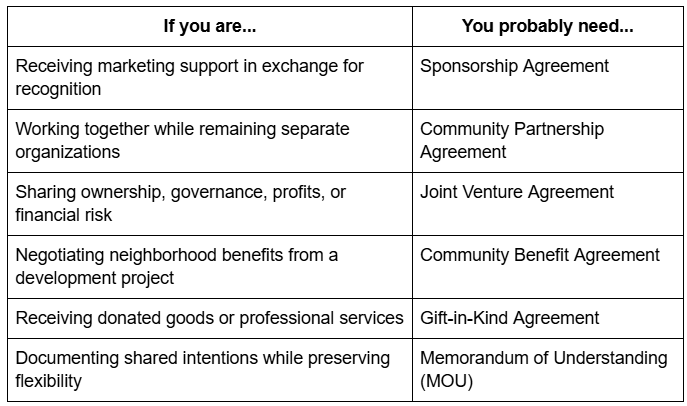
Strong Agreements Build Strong Communities
The best agreements are not only about preparing for conflict. They are about creating clarity. They establish expectations, allocate responsibility, strengthen governance, reduce misunderstandings, manage risk, and allow organizations to focus on serving their communities rather than resolving avoidable disputes.
At Narwhal Law and Business Strategy, we help for-profit businesses, nonprofits, public agencies, foundations, and community organizations throughout Oregon and Washington build collaborations that are practical, legally sound, and designed to last. Whether you are sponsoring an event, launching a new community initiative, negotiating a Community Benefit Agreement, accepting a significant gift, developing affordable housing, forming a joint venture, or simply trying to determine whether you need an MOU or a formal contract, choosing the right legal framework is an investment in the partnership itself.
Strong partnerships create stronger organizations, and stronger organizations build stronger communities.
